

Wilford Andersen (‘76) Shares “The Knowledge of Becoming” as Part of BYU Honored Alumni Address
Written by Spencer Schlag
Wilford Andersen (‘76) was honored as BYU Law’s 2024 Honored Alumni and gave a talk entitled “The Nuance of Knowing” as part of BYU’s Homecoming on October 14. Since attending BYU Law, Elder Andersen has worked as in-house counsel for Bank of America and as the managing partner of Andersen Investments. He later served with his wife as mission leaders in the Mexico Guadalajara Mission and as a General Area Authority Seventy of The Church of Jesus Christ of Latter-day Saints.
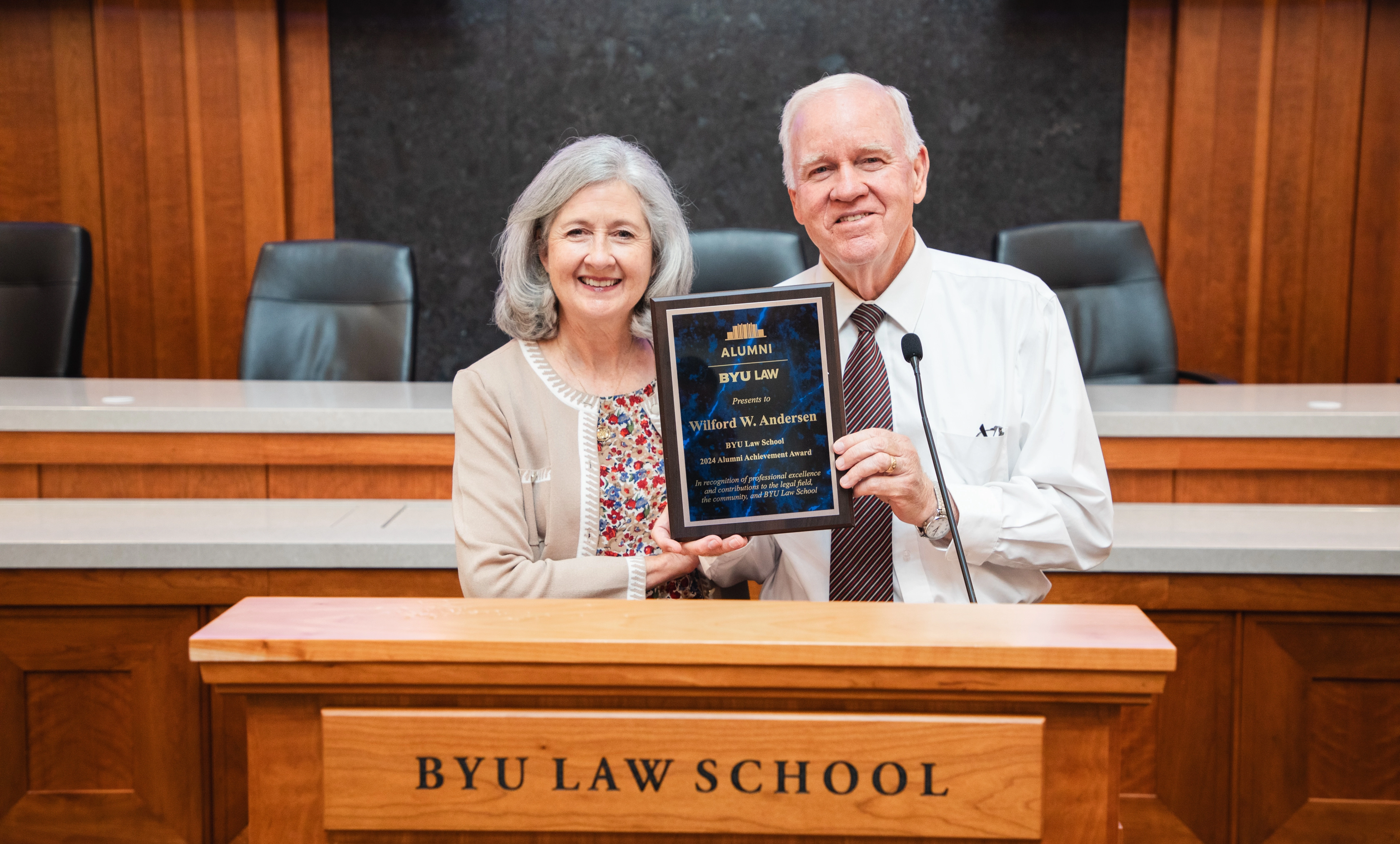
In his formative years as a member of BYU Law’s charter class, Andersen began to develop an understanding of the importance of knowledge in shaping one’s course in life. He recalled an address given by the law school’s founding dean, Rex E. Lee, who was both sage and sanguine on a myriad of topics. In the address, Dean Lee emphasized the need for a testimony of the truth of the gospel of Jesus Christ, asserting that it is the most important thing that a person can know. In closing, Lee charged the charter class to remember his testimony of the gospel even if they forgot everything else he had taught them. Andersen never forgot that poignant moment.
Throughout his successful education and career, Andersen gained important knowledge and applicable experiences. He obeyed the command found in the scriptures to learn by study and by faith and taught the Law School audience about three distinct kinds of knowledge. Andersen recognizes that the type of knowledge gained through study alone–what he has dubbed “head knowledge”–is important. While academic pursuits are essential, Andersen also highlighted the importance of another kind of knowledge: “heart knowledge.”
Andersen describes “heart knowledge” as the understanding gained through faith—faith not in oneself, but in Jesus Christ. The acquisition of heart knowledge comes through feelings rather than thoughts. Heart knowledge can solve some of the problems that arise if an individual’s entire understanding of the world comes strictly from academic knowledge. One problem that Andersen addressed was that we sometimes discount what other people say they know, simply because it does not fit with what we think. While heart knowledge is not always verifiable in an academic context, it is still a valid form of knowledge that is vital for our spiritual growth.
Part of obtaining heart knowledge involves seeking God’s direction. As Andersen put it, “We have to align ourselves with the powers of heaven and God’s will.” We can do so by having faith and acting upon it. Referencing James 2:26, which states,“Faith without works is dead,” Andersen emphasized the necessity of action. When we gain heart knowledge, the Holy Ghost can be with us. The companionship of the Spirit prompts and encourages us to act and to change.
As illustrated in Mosiah 5:2, the Holy Ghost can bring about a “mighty change in us, or in our hearts, that we have no more disposition to do evil, but to do good continually.” Andersen said, “The key is to want what we should want.” This desire comes directly from the Holy Ghost. By having and acting upon such righteous desires, we align our will with the will of Heavenly Father.
Andersen referred to this change as “becoming.” As we move forward in the process of becoming, we are blessed with the “knowledge of becoming,” which grows from repeatedly and consistently applying heart knowledge, developing what could be compared to spiritual muscle memory. Living the correct principles of the gospel of Jesus Christ allows us to gain this kind of knowledge that is both important and lasting.
Because the process of becoming can be hard to understand, Andersen masterfully compares the knowledge of becoming to learning to play the piano. Learning piano is a gradual process that involves multiple steps. First, the beginning student must learn the music. This requires looking at the notes, dynamics, and theories that go into music. Although this is a vital step in the learning process; it is not sufficient to produce a piano virtuoso.
After garnering head knowledge of the music, the student must learn to love the music. This involves truly feeling and appreciating the music. In this step, the student gains heart knowledge about the piece. Even with these two completed steps, the student will not be able to fully and effectively play the music. The third essential step in the process is to practice the music. The piano student plays the piece repeatedly, applying the head and heart knowledge previously acquired. This practice brings together the first two types of learning in perfect harmony and results not only in the performance of a beautiful piece of music but also in the development of an increasingly skilled and evermore dedicated pianist.
Similarly, we must apply the different kinds of knowledge that we gain. As we practice what we have learned, a lasting change occurs in our lives. The knowledge that we have already gained is reinforced, and we even gain new knowledge that is essential for our growth. Andersen illustrated this point with John 7:17: “If any man will do his will, he shall know of the doctrine, whether it be of God, or whether I speak of myself.” Action is essential in understanding the doctrine of Jesus Christ.
While academic and spiritual knowledge are vital, they require an extra step: application. As we apply the thoughts and feelings that come to our minds and hearts, we will have a desire to align ourselves with the will of God. This alignment further fosters our desire to do more and to become more. Applying the doctrine of Christ, through both head knowledge and heart knowledge, allows us to change and become true disciples of our Savior.
BYU Charter Class Member and 2024 Honored Alum Wilford Andersen is a prime example of how to gain heart and head knowledge throughout life, but also of how to apply this knowledge and become a true disciple of Jesus Christ.