
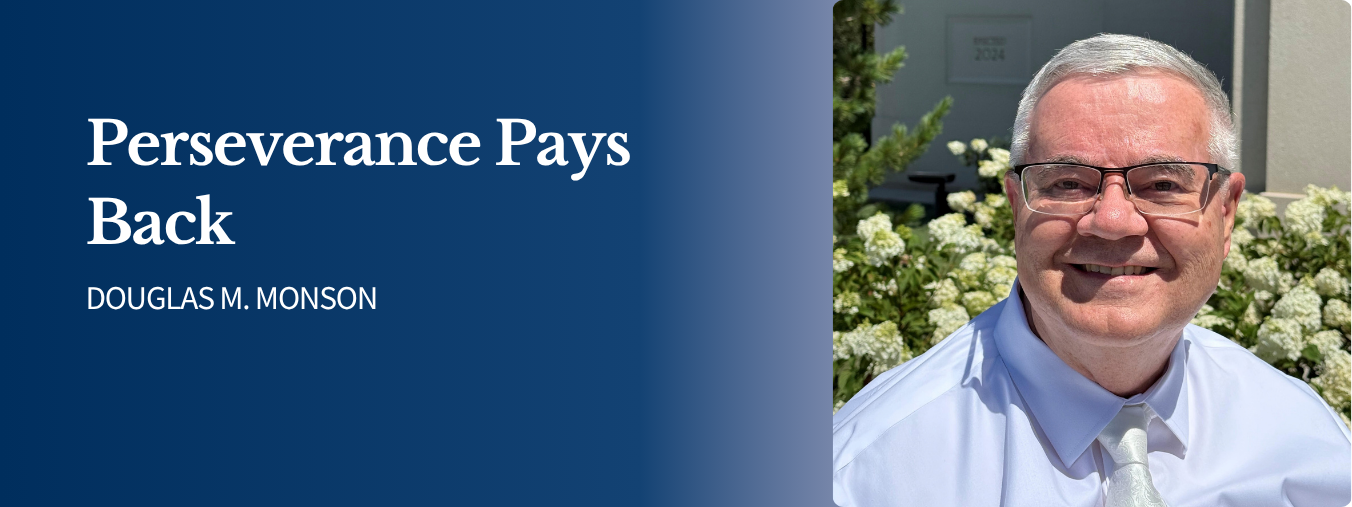
Perseverance Pays Back: Douglas M. Monson (‘81)
By Emily Madsen
A Life Shaped by Perseverance, Service, and Relationships
Doug M. Monson (‘81) learned early in his career that life does not always unfold according to plan. Today, he keeps a folder filled with rejection letters from jobs he applied for over the years, including two from Ray Quinney & Nebeker, the firm where he would eventually build much of his career. To Doug, those letters are a reminder of a lesson he has carried with him throughout his life: “perseverance pays back.” “You can get rejected in life and keep moving on,” he said. “You just have to have faith that the situation that works best for you will happen to you. Hold on and listen to the spirit and hope that whatever will be best for you will.”
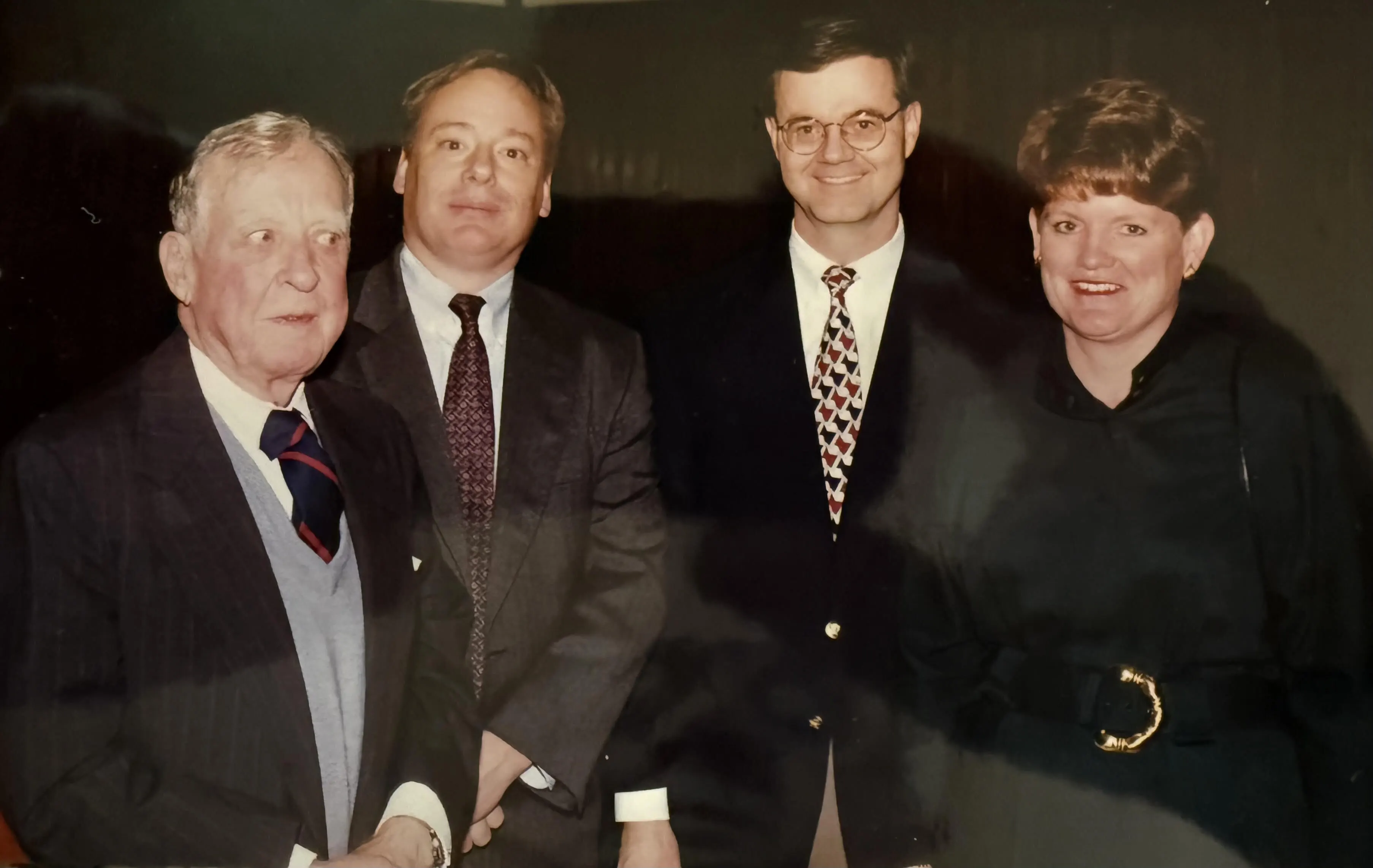
Doug Monson and his wife, Lisa. (1997)
Looking back, Doug can see that some of the experiences he could not have planned ended up becoming some of the most meaningful parts of his life. After earning his undergraduate degree from the University of Utah, Doug graduated from BYU Law in 1981 with his life still largely ahead of him. He had a clerkship lined up, but no permanent job and, as he put it, “life was a big adventure.” His clerkship took him to Memphis, Tennessee, where he worked for Judge Bailey Brown, whom he describes as “the epitome of a perfect southern gentleman.” He also met some of his best friends and his future wife. Although both he and his wife were originally from Utah, Doug feels that meeting her in Memphis was meant to be. That sense of trust in how life unfolds has remained with him throughout his career. Although Doug could not have known where his clerkship would lead him, his time at BYU Law had already given him the lessons he would carry with him throughout his career.
Learning to Think Like a Lawyer
For Doug, one of the most lasting lessons of BYU Law was learning a different way of thinking. Law school taught him how to work through complicated issues logically, a skill that has served him not only in the legal profession but also in his family, church service, and relationships with others. “That training and experience has been helpful in my profession, career, in my family, in church callings I’ve had, and opportunities to counsel with other people,” he said. But Doug has also learned that legal reasoning has its limits, particularly at home. He joked that his wife has occasionally had to tell him to “stop cross examining me.”
Legal training can make it easy to approach disagreements as problems to be solved, he explained, but sometimes people simply need to be given the opportunity to explain themselves. That lesson has been especially valuable in his service to others. Doug recently served in a stake presidency that faced several complicated matters, and the stake president often turned to him because of his legal training. Doug helped him understand what the law was and how it could apply to particular people and circumstances. For Doug, experiences like these have shown him that the value of a legal education extends far beyond the practice of law.
“The Golden Rule” and Lessons of Hope
Doug spent most of his career working on banking matters, including transactions and restructuring work for businesses experiencing financial difficulties. Over the years, he has seen businesses succeed, struggle, and ultimately fail, and those experiences have shaped some of his strongest convictions. One of the most important lessons he has learned is the value of honesty. Doug has seen the consequences when business owners become unwilling to acknowledge a problem and instead try to hide it. What might have been a difficult but manageable situation can become much worse when lenders, employees, owners, and other stakeholders do not have an accurate picture of what is happening. “It’s heartbreaking to see that people just get greedy or desperate in a failing business situation and they’re not honest and upfront with their lenders, owners, employees,” he said. By contrast, Doug has also seen situations where business owners were honest with their lenders about the difficulties they were facing, and found that the lenders were willing to work with them. His advice is simple: follow the Golden Rule. “Treat others the way you want to be treated,” he said. “If I were an outside party, would I want to be treated this way?”
His career has also taught him not to panic when circumstances become difficult. Doug has watched the business world move through numerous boom-and-bust cycles, and while experience does not make those periods stress-free, it has given him perspective. “Younger people think it’s coming to an end, but us older people know that we’ve had market crashes before,” he said. “You have to hang on. You can’t just panic and throw yourself away when things get tough.” That perspective has contributed to his continued optimism. Despite the difficulties he sees in the world, Doug believes that most people ultimately want to care for their families and do good. “I’m still very hopeful about the world because of that,” he said.
Making Time for What Matters
After decades in a demanding profession, Doug has learned another lesson that has nothing to do with contracts, transactions, or restructuring: relationships matter. The legal profession can be stressful, with deadlines and complicated problems that require intense thought and attention. But Doug has found that strong relationships with colleagues can make those difficult periods easier. He recently saw an example of this when one of his colleagues shared that his wife was undergoing surgery. Other members of the group immediately asked how they could help. That kind of support, Doug said, is invaluable.
The same principle applies at home. Doug believes lawyers need to establish boundaries around their work so that their careers do not consume the time they could spend with their families. “Law can consume you and your time,” he said. “You have to step back and have those times with your wife and with your children. Those are the experiences you will be thinking about in your retirement age.” Now, as he approaches retirement, Doug can see the wisdom in that advice. The memories he values most are not necessarily the hours he spent at the office, but the experiences he made time for along the way. Throughout his career, Doug made an effort to be present for the things that mattered to his family. When one of his children had a lacrosse game, for example, he could make arrangements to attend. His work was flexible in some ways, but there was always a tradeoff. When people asked him what his hours were, he would tell them, “I get there when I get there, but I have to stay until the work is done.” One of his favorite sayings captures the balance he tried to maintain: “You can trade time for money or money for time.” There are seasons when work requires more time and seasons when there is more flexibility. The important thing, Doug believes, is to recognize that balance cannot simply be postponed until retirement. “You have to set those boundaries and not say, ‘I’m going to wait until retirement to do that,’” he said. “You have to do that along the way.”
Looking Back and Looking Ahead
Now, as Doug approaches retirement, he has found himself reflecting on just how much of his identity has become intertwined with being an attorney. “It’s interesting how much my identity is wrapped up in my career and position as an attorney and lawyer,” he said. After 48 years since he began law school, stepping away from the profession has made him realize that a career can become much more than a job. It becomes part of the way a person understands himself.
Although retirement has prompted Doug to reflect on the past, he remains interested in what lies ahead, both for himself and for the legal profession. One of the questions he is considering is how artificial intelligence will change the work lawyers do. But he believes there will always be a need for something technology cannot replace: human judgment and the ability to counsel people. “There is a great deal of human judgment that AI is never going to replace, like providing valuable advice that a machine can’t,” he said. Doug also believes lawyers play an important role in society by helping people resolve disagreements through laws, rules, and contracts rather than through conflict. “Lawyers help people solve their disputes in a civilized way,” he said. “That’s a big benefit to society that most people aren’t thinking about.” His advice to current law students, then, is not simply to prepare for a career. It is to recognize the opportunities that a career can provide to serve other people.
A Small Corner of the World
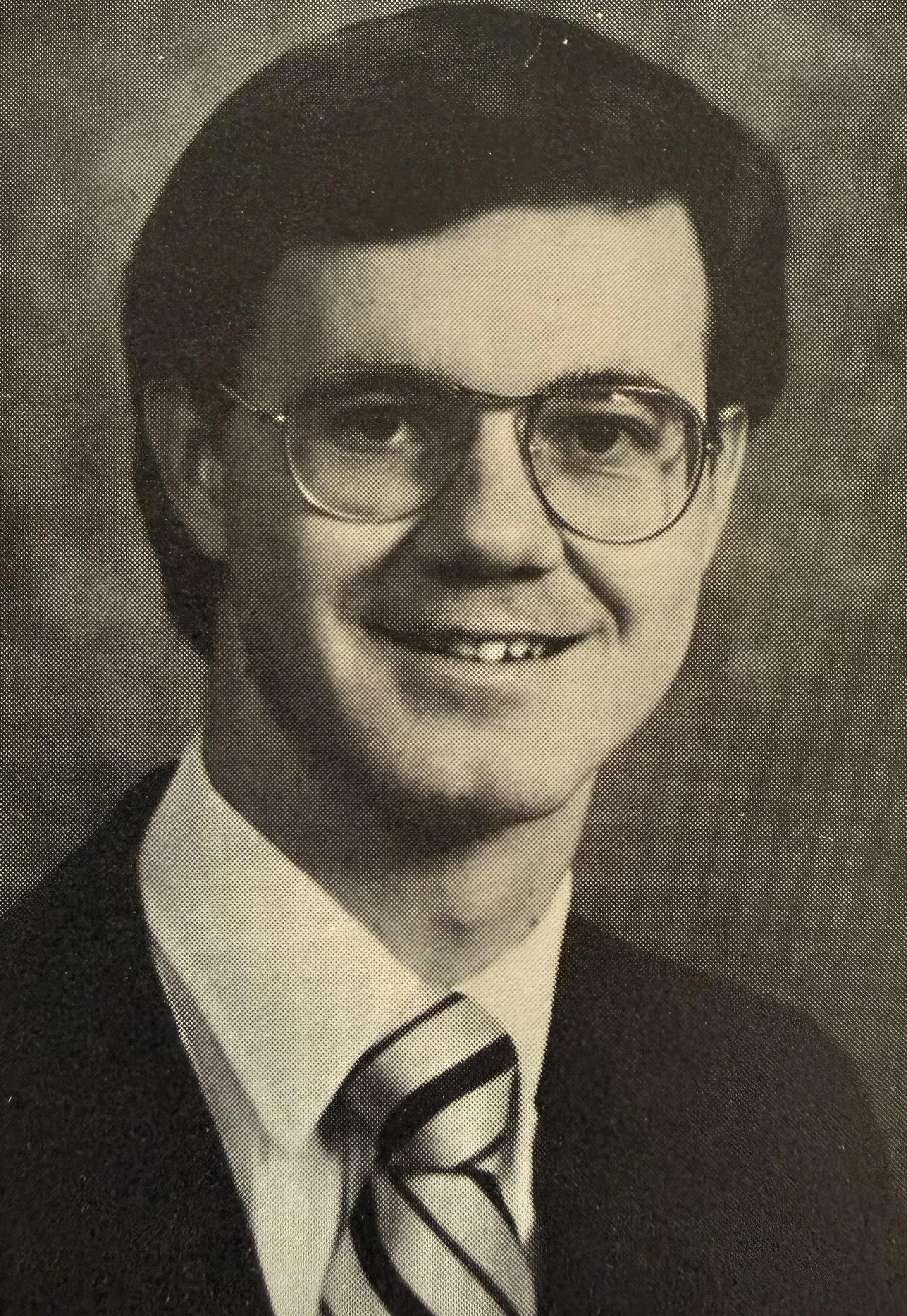
As the Class President for the Class of 1981, Doug recently took the lead in organizing his BYU Law class’s 45th reunion, which was celebrated in early September at BYU Law. What he initially expected to be a lot of work and “drudgery” has instead given him an opportunity to reconnect with classmates and reflect on the experiences they shared. He remembers that law school was challenging for many of his classmates. They had all been accustomed to being at the top of their classes, only to enter a new environment where everyone was suddenly surrounded by other high-achieving students. For some, that adjustment made law school a difficult experience. The reunion has offered an opportunity to look back on those years with a different perspective and reconnect with people who shared them.
As Doug looks back on nearly five decades since beginning law school, he does so with gratitude for his family, his education, his career, and the opportunities he has had to serve his community and church. He doesn't believe he would change anything about his life. “I’m not famous,” Doug said, “but in my small corner of the world I’ve been able to have a positive influence on other people.”