
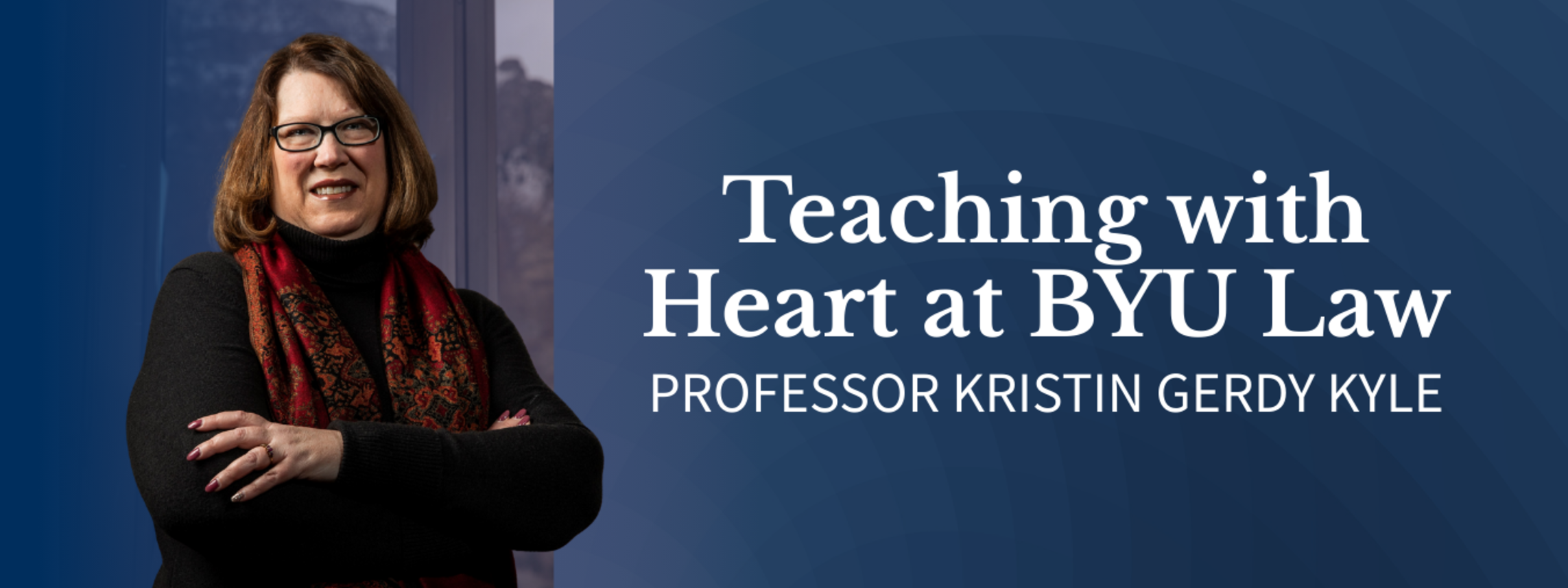
Called to Teach: Kristin Gerdy Kyle (‘95)
By Emily Madsen
If you step into Professor Kristin Gerdy Kyle’s office, you’ll notice something you don’t see in many law schools: a couch lined with stuffed animals. They’re there for students who need to sit, breathe, cry, or simply hold something while navigating one of the most demanding seasons of their lives. That small detail captures much of who Professor Gerdy Kyle is and why her influence at BYU Law has been so enduring.
An Unconventional Beginning
Professor Gerdy Kyle’s path to BYU Law was anything but traditional. In fact, BYU Law was the only law school she applied to. She didn’t even take the LSAT until June of the year she began law school, well after the typical admissions timeline. Law school had crossed her mind as an undergraduate, but it wasn’t until graduation day, when she ran into a friend who was going to be a 3L at BYU Law, that the idea became real.

She emailed admissions explaining that she planned to take the LSAT and apply the following year. Instead, she took the test, did well, and soon found herself facing an unexpected phone call the Friday before intro-to-law week: BYU Law wants you and needed to know by 5 p.m. that day whether she would be enrolling. Classes started the following Monday.
Looking back, Professor Gerdy Kyle sees that moment as one of many signals that she was exactly where she was meant to be. Her place in the class of 1995 proved foundational, not only professionally but personally. Many of the people she loves most came from that cohort, and she reflects with deep gratitude on the relationships she formed and the timing that made them possible.
Discovering a Calling to Teach
By the end of her 2L year, Professor Gerdy Kyle knew she loved law school, but not the idea of practicing law. During her 2L summer, she turned down a large-firm offer and returned to her undergraduate job. That summer became transformative. She helped complete a faculty member’s book after his passing and immersed herself in studying the teachings of President Howard W. Hunter following President Ezra Taft Benson’s death.
Just one week before her 3L year, she was unexpectedly asked to teach a Teachings of the Prophets class. At 24 years old, newly endowed and not a returned missionary, her first instinct was to say no. But she accepted, and within days, she fell in love with teaching.
Her 3L year confirmed that calling. In addition to teaching, she served as a legal writing TA, competed in moot court, and helped run first-year competitions. At a time when BYU Law had no formal legal writing curriculum, she found joy in helping students learn how to write and think like lawyers. “This is really cool,” she remembers thinking. “I really love this.”
Building Legal Writing at BYU Law
 After graduation, Professor Gerdy Kyle returned to BYU Law part-time, then full-time, eventually choosing the law school over a position in the religion department because it allowed her to keep “her feet in both worlds.”
One of the most significant chapters of her career began when Dean Hansen and Constance Lundberg, then director of the law library, sought to strengthen BYU Law students’ legal writing. Legal writing was emerging nationally as a discipline, and Professor Gerdy Kyle was sent to Chicago, where she found what she describes as “her tribe”—others deeply interested not just in the law, but in how it is communicated.
After further teaching in Philadelphia, she returned to BYU Law as director of the legal writing program. Though other institutions invited her to stay, she felt strongly that BYU was where she belonged. Here, she says, she can “teach the laws of man in light of the laws of God,” bringing her full authentic self—faith, compassion, empathy—into the classroom.
Students at the Center
Despite numerous professional accomplishments, Professor Gerdy Kyle is clear about what matters most to her: the students. She said, “I’ve done some cool things and written some cool things, but they’re the highlights.” Since 1992, she has interacted with nearly every BYU Law student, celebrating their successes and supporting them through challenges. She follows their lives as they become legislators, judges, law professors, partners at firms, and leaders in their communities and the Church.
Her commitment to students is especially evident in how she approaches well-being. After several students emailed her about missing class due to mental health struggles, she scrapped her planned lesson and led a conversation about staying grounded. That conversation has since become an annual tradition, complete with a basket of small items meant to remind students that they are supported. Her office remains a place where students can come, not just to talk about writing, but about life.
Leadership and Lifelong Connections
In addition to her role as professor and mentor, Professor Gerdy Kyle serves as class president for the class of 1995, a role that reflects how deeply she values relationships. She stepped into the position after a meaningful reunion, recognizing that as classmates’ lives grew fuller and more scattered, someone needed to help keep them connected.
That commitment mirrors her leadership more broadly. When she chaired the 2024 J. Reuben Clark Society Annual Conference with just three months to prepare, she watched the BYU Law community and its extended network rally immediately. Judges, faculty, and leaders responded without hesitation. “For you and for BYU Law School, I will do anything,” Heidi K. Hubbard, a main keynote speaker, told her. The conference became one of the most meaningful experiences of her career.
Meant to Be Here
When asked recently to speak about how teaching at BYU Law has brought her closer to Christ, Professor Gerdy Kyle reflected on authenticity and wholeness. Teaching here, she says, allows her to be fully herself without compartmentalizing faith, work, and humanity.
Her journey to BYU Law may have been unconventional, but to those who know her, and to generations of students she has mentored, it feels unmistakably inspired. As she puts it simply: “These are my people.”